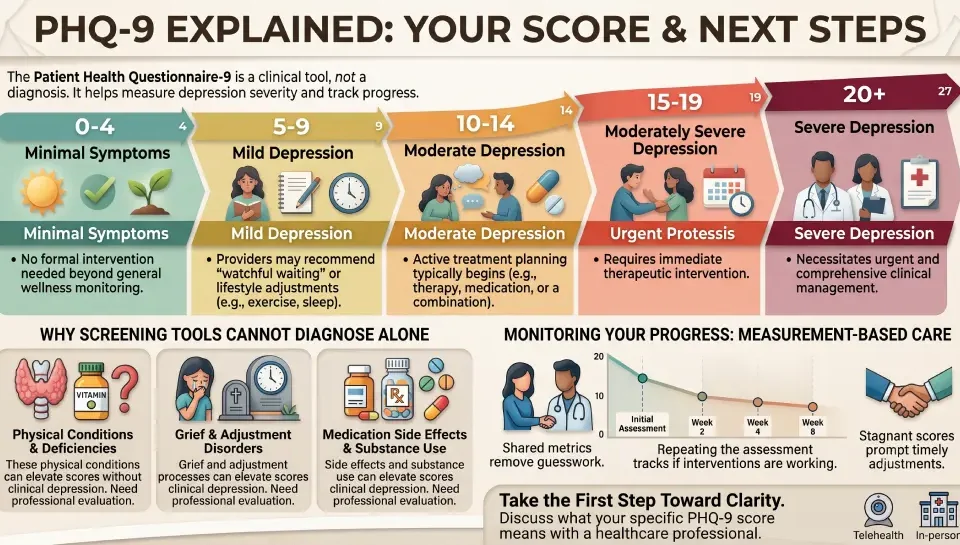
If your antidepressant has stopped working or never worked at all, you are not out of options. This is more common than most people realize. At MindBodyPinnacle Health in Laurel, MD, we specialize in what comes next: advanced treatments designed specifically for people who haven’t found relief through medication alone.
What does it mean when antidepressants stop working?
Antidepressants help a lot of people. But they don’t help everyone, and for some, the relief they once provided fades over time.
When a person doesn’t respond adequately to two or more antidepressants tried at an adequate dose and duration, clinicians use the term treatment-resistant depression (TRD). According to the National Institute of Mental Health, roughly one-third of people with major depression do not achieve full relief from standard antidepressant treatment.
That’s not a personal failure. It’s a clinical reality, and it has real solutions.
If you’ve been through multiple medications and still don’t feel like yourself, there’s a name for what you’re experiencing. And there are treatments specifically built for it.
Why do some antidepressants stop working over time?
It’s a question a lot of patients ask, and it deserves a direct answer.
Antidepressants work by adjusting brain chemistry, primarily serotonin, norepinephrine, and dopamine. For some people, the brain adapts to those adjustments over months or years, reducing the medication’s effect. This is sometimes called antidepressant tolerance, or tachyphylaxis.
In other cases, the medication never fully worked to begin with; the dose was too low, the duration too short, or the medication simply wasn’t the right fit for that person’s biology.
Here’s what that leads to in real life: years spent switching from one prescription to the next, managing side effects, feeling brief windows of hope followed by familiar heaviness. If that sounds like your experience, you don’t have to keep doing that.
How is treatment-resistant depression different from regular depression?
Both feel like depression. The difference is in how the brain is responding or not responding to standard treatment.
Treatment-resistant depression (TRD) is typically defined as depression that hasn’t improved after trying at least two different antidepressants at the right dose, for the right amount of time. Some patients come to us having tried five or six medications over many years.
TRD tends to be more severe, longer-lasting, and more likely to interfere with daily functioning. Sleep problems, fatigue, difficulty concentrating, and persistent low mood are common. But again, this is a clinical distinction, not a reflection of how hard you’ve tried or how strong you are.
What changes with TRD is the treatment approach. Standard antidepressants are no longer the starting point. We look at options designed specifically for brains that haven’t responded the way we hoped.
What are the advanced treatment options when antidepressants aren’t enough?
This is where things get more promising than most patients expect.
At MindBodyPinnacle Health in Laurel, MD, we offer several evidence-based options for people who haven’t responded to antidepressants:
NeuroStar TMS Therapy: Transcranial Magnetic Stimulation (TMS) is an FDA-cleared, non-invasive treatment that uses magnetic pulses to stimulate the areas of the brain involved in mood regulation. There’s no medication, no sedation, and no downtime. Patients come in for a session and leave to go about their day. TMS is available at our Laurel, MD location only.
Spravato (Esketamine): Spravato is an FDA-approved nasal spray treatment for treatment-resistant depression. It’s administered in our clinic under supervision and works through a different mechanism than traditional antidepressants, targeting the brain’s glutamate system rather than serotonin. Many patients report feeling improvement within days, not weeks. Spravato is available at our Laurel, MD location only.
GeneSight Genetic Testing: Before concluding that no medication will work, it’s worth knowing whether your medication choices have been informed by your actual biology. GeneSight is a pharmacogenomic test that analyzes your DNA to show how your body is likely to process psychiatric medications. It removes years of guesswork from the medication trial-and-error process and helps your provider make a more targeted decision.
Specialist Medication Management: Sometimes the issue isn’t the medication itself; it’s the combination, the dose, or interactions that weren’t caught. Our providers review your full psychiatric history and bring a specialist lens to medication decisions that goes beyond a general practitioner’s scope.
Each of these options is worth a real conversation. And that conversation starts with a single appointment.
What is TMS therapy and is it right for me?
TMS therapy is often the first question patients have when antidepressants haven’t worked, and it’s a reasonable place to start.
TMS uses magnetic fields similar in strength to an MRI to gently stimulate underactive neurons in the prefrontal cortex, the part of the brain most associated with depression. It’s outpatient, non-invasive, and covered by many insurance plans.
A typical TMS session at MindBodyPinnacle takes about 20-40 minutes. You’re awake the whole time. You sit in a chair, a device rests lightly against your scalp, and you feel a tapping sensation. There’s no anesthesia. No recovery time. Most patients complete a course of treatment over several weeks and continue their normal daily routines throughout.
TMS is FDA-cleared for major depressive disorder and is effective in patients who have not responded to antidepressant medication. It is available at our Laurel, MD clinic.
What is Spravato and how is it different from other treatments?
Spravato (esketamine) was FDA-approved specifically for treatment-resistant depression and major depressive disorder with acute suicidal ideation. It works differently than any antidepressant you’ve likely tried.
Traditional antidepressants target the serotonin or norepinephrine systems and can take four to six weeks to show results. Spravato targets the glutamate system, a different pathway entirely. Many patients begin to notice improvement within the first few sessions.
Spravato is administered as a nasal spray in our Laurel, MD clinic. You stay on-site for a monitoring period after each dose. It’s typically used alongside an oral antidepressant as part of a broader treatment plan. Our team walks you through exactly what to expect before you begin.
Insurance coverage for Spravato varies. Our care coordinators can verify your benefits before you commit to anything.
How does GeneSight genetic testing help with depression treatment?
If you’ve cycled through several antidepressants without lasting relief, it’s worth asking whether those medications were matched to your biology or prescribed based on general guidelines.
GeneSight analyzes your DNA to identify how your body metabolizes specific psychiatric medications. It shows your provider which medications are likely to work well for you, which may cause significant side effects, and which ones your body may process too quickly or too slowly to be effective.
It’s a simple cheek swab. Results come back within a few days. And they can meaningfully change the medication conversation.
For patients who haven’t responded to standard antidepressants, GeneSight often reveals why and points toward better options before spending more years trying medications that aren’t a good fit.
How do I get started with advanced depression treatment in Laurel, MD?
The process at MindBodyPinnacle is straightforward.
You can book a new patient appointment often within 24 hours at our Laurel, MD location or via telehealth for general psychiatric care across Maryland, Virginia, and Washington, D.C. At your first appointment, we review your full treatment history, discuss what you’ve tried, and talk through the options that make sense for where you are right now.
For TMS and Spravato, there is an intake process that includes a short interest form and insurance verification before beginning treatment. Our care coordinators handle all of that with you directly; you don’t have to figure it out alone.
Frequently Asked Questions
Q: What is treatment-resistant depression? Treatment-resistant depression (TRD) is a clinical term for depression that has not responded adequately to at least two different antidepressants, each used at the right dose and for an appropriate length of time. It affects roughly one-third of people with major depression. TRD is a medical condition, not a sign that a person isn’t trying hard enough.
Q: Is TMS therapy available in Laurel, MD? Yes. MindBodyPinnacle Health offers NeuroStar TMS therapy at our Laurel, MD clinic (9811 Mallard Dr #210, Laurel, MD 20708). TMS is not available at our Alexandria, VA location. Call us at (443) 713-8643 or book online to discuss whether TMS is right for you.
Q: Does insurance cover TMS therapy in Maryland? Many major insurance plans cover TMS for treatment-resistant depression, including Aetna, BCBS, Cigna, UnitedHealthcare, Tricare, and Maryland Medicaid. Coverage depends on your plan and prior treatment history. Our team verifies benefits before you begin; there are no surprise costs.
Q: Is Spravato covered by insurance? Spravato (esketamine) is FDA-approved for treatment-resistant depression and is covered by many insurance plans when specific clinical criteria are met. MindBodyPinnacle’s care coordinators verify Spravato benefits as part of the intake process at our Laurel, MD location.
Q: What is the difference between TMS and antidepressants? Antidepressants work chemically; they adjust neurotransmitter levels in the brain. TMS works physically; it uses magnetic pulses to directly stimulate underactive areas of the brain involved in mood. TMS does not involve medication, has no systemic side effects, and does not require sedation or recovery time.
Q: Can I get depression treatment via telehealth in Maryland, Virginia, or DC? Yes. MindBodyPinnacle offers telehealth psychiatric care across Maryland, Virginia, and Washington, D.C. Telehealth appointments are appropriate for general depression treatment and medication management. TMS and Spravato are in-clinic treatments available at our Laurel, MD location only.
Ready to Talk About What’s Next?
You’ve tried a lot. That counts for something. If you’re at the point where standard medications haven’t worked or have stopped working, there are real options we haven’t exhausted yet.
At MindBodyPinnacle Health, we see new patients often within 24 hours. Our team in Laurel, MD specializes in treatment-resistant depression, including TMS therapy, Spravato, GeneSight testing, and specialist medication management.
Book your appointment online or call us directly at (443) 713-8643.
📍 Laurel, MD · Alexandria, VA · Washington D.C. · Telehealth across MD, VA & DC
Sources:
National Institute of Mental Health. Depression. https://www.nimh.nih.gov/health/topics/depression
U.S. Food and Drug Administration. FDA approves new nasal spray medication for treatment-resistant depression. https://www.fda.gov/news-events/press-announcements/fda-approves-new-nasal-spray-medication-treatment-resistant-depression-available-only-certified