Taking a mental health screening can feel intimidating. You answer nine simple questions about your mood and daily habits over the past two weeks. Then you see a number. That single digit might validate years of silent struggle or spark confusion about what comes next. The Patient Health Questionnaire-9 is not a diagnosis. It is a validated clinical tool that helps providers measure depression severity and track treatment progress over time. Understanding this score empowers you to have a more productive conversation with your healthcare team about your specific needs and options.
Decoding the PHQ-9 Scoring System
The PHQ-9 assigns points based on how often symptoms bother you. Scores range from zero to twenty-seven. Each threshold suggests a different level of care intensity. Research archived in PubMed Central confirms these cutoffs reliably correlate with clinical depression severity across diverse populations.
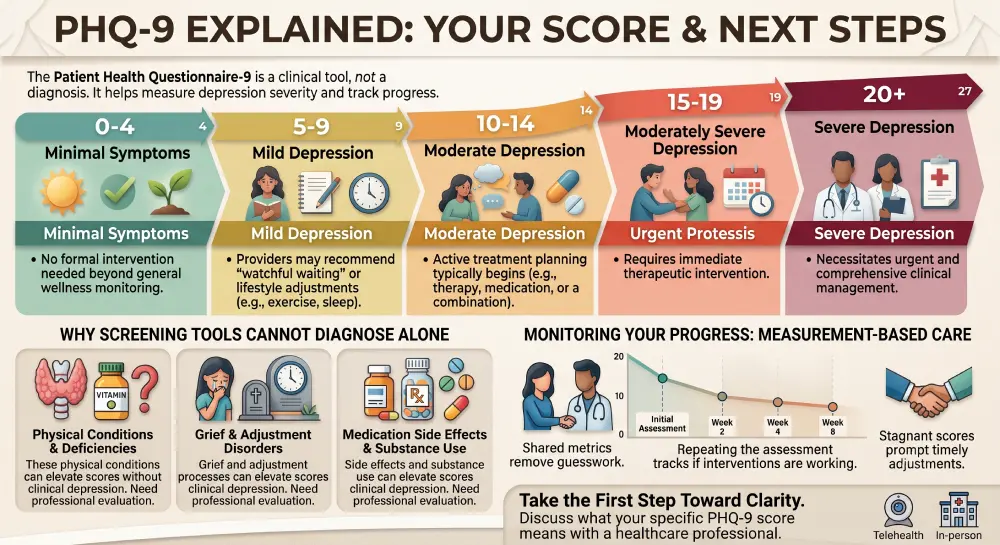
A score between zero and four indicates minimal or no depression. This range typically requires no formal intervention beyond general wellness monitoring. Scores from five to nine suggest mild depression. Providers often recommend watchful waiting or lifestyle adjustments at this stage. Ten to fourteen points signal moderate depression where active treatment planning usually begins. Fifteen to nineteen represents moderately severe depression requiring immediate therapeutic intervention. Twenty or higher indicates severe depression necessitating urgent and comprehensive clinical management.
These numbers serve as conversation starters rather than absolute verdicts. Your lived experience matters just as much as the calculation. A person scoring twelve might function adequately at work while feeling internally devastated. Another individual scoring eight might be experiencing significant impairment due to specific symptom clustering. Clinical context always overrides raw data.
Why Screening Tools Cannot Diagnose Alone
Many people mistakenly believe a high PHQ-9 score equals a major depressive disorder diagnosis. This assumption misses the nuance of psychiatric evaluation. The National Institute of Mental Health emphasizes that standardized screeners identify risk but cannot capture the full diagnostic picture required for accurate treatment planning.
Physical conditions like thyroid dysfunction or vitamin deficiencies mimic depressive symptoms perfectly. Grief reactions and adjustment disorders also elevate scores without meeting criteria for clinical depression. Medication side effects and substance use patterns further complicate interpretation. Only a thorough evaluation by a qualified clinician can differentiate between these overlapping presentations.
This distinction protects patients from unnecessary medication or missed underlying medical issues. It also prevents dismissing genuine suffering simply because a score falls below an arbitrary threshold. Trust your internal compass alongside the external metric.
Translating Scores Into Personalized Treatment Plans
Your PHQ-9 result directly informs which interventions make sense right now. Mild scores often respond well to psychotherapy alone or structured lifestyle modifications. Regular exercise and sleep hygiene improvements show measurable impact in this range according to data from the Centers for Disease Control and Prevention. Moderate scores frequently benefit from combining therapy with medication management. Severe scores may require intensive outpatient programs or specialized interventional treatments.
MindBodyPinnacle Health tailors recommendations based on this severity gradient plus your unique history. Someone with moderate depression who has failed multiple medication trials might be an ideal candidate for transcranial magnetic stimulation rather than another pharmaceutical rotation. A patient with mild symptoms but strong social support might thrive with biweekly counseling instead of weekly sessions. Treatment is never one-size-fits-all regardless of what the screening suggests.
Accessing Care Through Telehealth and In-Person Options
Geography should never dictate mental health access. MindBodyPinnacle Health offers comprehensive telehealth evaluations for residents throughout Laurel, MD, Alexandria, VA, and Washington D.C. Virtual visits provide the same clinical rigor as office appointments while eliminating commute stress and scheduling barriers. Initial assessments via video allow clinicians to establish baseline PHQ-9 scores and develop preliminary treatment plans from home.
Certain advanced therapies require physical presence for safety and efficacy. In-person treatment services remain available at our Laurel, MD and Alexandria, VA locations for procedures like TMS therapy and Spravato administration. These FDA-cleared interventions target treatment-resistant depression when standard approaches fall short. Our team coordinates seamlessly between virtual check-ins and on-site procedures to maintain continuity. Learn more about our specialized approach to depression and related disorders to understand which modality fits your current needs.
Monitoring Progress Beyond the Initial Assessment
The true power of the PHQ-9 emerges during follow-up care. Repeating the assessment every few weeks creates objective data showing whether interventions are working. Stagnant scores prompt timely adjustments before crises develop. Improving scores validate that the current path deserves continuation even if subjective feelings lag behind numerical gains.
This measurement-based approach removes guesswork from mental healthcare. You and your provider collaborate using shared metrics rather than vague impressions. Some patients find watching their score decrease over months profoundly motivating during difficult recovery phases. Others discover that persistent elevation despite apparent improvement signals unresolved trauma or comorbid anxiety needing separate attention. Numbers tell stories that words sometimes miss.
Taking the First Step Toward Clarity
Understanding your PHQ-9 score transforms uncertainty into actionable insight. Whether your result suggests minimal concern or urgent need, the path forward starts with professional guidance. Self-scoring online provides information but lacks the interpretive expertise necessary for safe decision-making.
MindBodyPinnacle Health serves communities across Maryland, Virginia, and the District of Columbia with both flexible telehealth evaluations and dedicated in-person treatment centers. Our clinicians integrate screening data with compassionate human judgment to build plans honoring your whole self. Schedule an appointment today to discuss what your score means specifically for you. Real relief begins when measurement meets meaningful connection.